
In the modern world, where equality and convenience are the gold standards of social life, stepping into an orthodox institution like the Uttaradi Maṭha or the Kudli Maṭha can feel like entering a different dimension. For a devotee, particularly a modern woman, navigating the rules of dress codes, complexities regarding menstruation, or the denial of certain rituals can sometimes feel restricting or even unfair. It is natural to ask: Why are there so many layers of rules for us? Why are women of a certain age treated with distance? Why does the saree matter so much?
However, to truly understand these practices, we must shift our perspective from social judgement to spiritual technology. The Maṭha is not merely a social hall; it is a “Spiritual Power Station” of divine energy (Sannidhana). The restrictions are not placed upon us to judge us, but around us to protect the delicate sanctity of that energy. To understand the restrictions placed on devotees, we must first look at the person sitting on the Peetha, the Seer himself.
Here is a perspective on why these traditions are invitations to a deeper spiritual discipline, rather than arbitrary rules.
The Seer’s Burden: A Life of “Fire”
Before we ask why the Swamiji (Seer) asks so much of us, we must see what he demands of himself. The Swamiji is a Sanyasi, an ascetic who has performed his own funeral rites (atma-shraaddha) while still alive. He has fully renounced “bhoga” (enjoyment) to live a life defined by the tapas, a discipline rooted in the Sanskrit syllable tap, meaning “To Heat” or “To Burn.”
- The Ultimate Discomfort:While we may find wearing a saree or dhoti inconvenient for an hour, the Swamiji wears simple, unstitched cloth 24 hours a day, in all seasons. He walks barefoot on rough stones and asphalt. He practices Eka Bhukti, eating only once a day—strictly cold, bland food that he is forbidden to reheat. He bathes in cold water in the pre-dawn hours, regardless of his age, health, or the weather.
- The Living Flame:This voluntary restriction of food, sleep, and comfort is designed to generate internal friction. In Yogic terms, this generates a spiritual heat that “cooks” or ripens the soul, burning away the impurities (mala) of karma. A Seer doesn’t just live; he smolders in the fire of his own discipline.
- The Vow of the Highest Spiritual Sanctity:His spiritual potency is maintained by strict brahmacharya (celibacy). He isolates himself not because he looks down on humanity, but to maintain the highest state of ritual purity required to burn the karmas of his devotees.
Therefore, when the Seer asks us to step back or adhere to a dress code, he is not imposing a burden; he is inviting us to share in a tiny, manageable fraction of his own immense fire.
Women of Menstruating Age: The “Distancing” as Protection
One of the most sensitive topics is the visible distance a Swamiji maintains from young and middle-aged women, even those who are not currently menstruating. He may not make eye contact. He may drop mantrakshata from a height or have an assistant give it. This is not discrimination. It is indriyanigraha (mastery over senses) that the Seer is enforcing upon himself.
- Potency of Life:A woman of child-bearing age represents Prakriti, the potent, creative force of nature. For a celibate monk, engaging closely with this energy, even visually, can act as a subtle disturbance to his rigorous vows of detachment.
- The Firewall:By maintaining distance, the Seer protects the integrity of his tapas (penance). He acts like a grounded wire handling high electricity. If he relaxes his guard, the “insulation” breaks. He distances himself out of respect for the woman’s power of attraction and the safety of his own vows. It is a protective protocol, much like how one treats powerful magnets with care.
The Protection of the Feminine Energy (Rajaswala)
Another painful point of contention is the exclusion of women during menstruation. In the modern view, it looks like exclusion. But in the ancient Vedantic view, it is rooted in Energetic Health.
The human body flows with different types of internal winds (Prana). During a woman’s cycle, her energy is naturally flowing downwards (Apana Vayu) in a process of cleansing and rest. The Maṭha, conversely, is a space of intense, upward-spiraling spiritual fire (Agni).
When Seers ask women in this state to stay away, it is an act of protective care. Mixing the intense “solar” energy of the Maṭha with the delicate “lunar” cleansing cycle of the woman is believed to create a spiritual clash that is jarring for the woman’s subtle body and disruptive to the silence of the Seer’s meditation.
This necessity for a total system disconnect is codified in the scriptures not as a moral condemnation, but as a functional command. The Vyāsa Smṛti (2.37) instructs a complete cessation of output during this cycle to protect the internal process:
योषितो नित्यकर्मोक्तं नैमित्तिकमथोच्यते ।
रजोदर्शनतोदोषात् सर्वमेव परित्यजेत् ॥
Yoṣito nityakarmoktaṃ naimittikamathocyate ।
Rajodarśanatodoṣāt sarvameva parityajet ॥
(Regarding the specific duties of women: Upon the appearance of the menstrual cycle, due to that specific energetic condition (dosha), she must completely disengage from all activities (sarvam eva parityajet)).
Just as one disconnects sensitive electronics during a power surge, the tradition mandates parityajet, a total disengagement to allow the apana vayu to flow without ritual interference. It is a period of rest (vishranti), allowing the woman to rejuvenate without the heavy demand of high-frequency rituals.
Saree: Flow vs. Fragment
Why is the saree insisted upon while jeans or salwars are rejected? Is it just about tradition? The distinction lies in the concept of prana (vital energy) and how cloth interacts with it. The core distinction in vedic physics is not just the shape, but the structural integrity of the cloth (akhanda vs. khanda /unstitched vs. cut). The Maṭhas function as guardians of this logic.
- Unbroken Flow (Akhanda Vastra):The Maṭha, based on the Vedic prism, views the human body as an energy circuit. The Saree (whether 6-yard or 9-yard) is one continuous stream of cloth. Because it is unstitched, it acts as a conductor, allowing energy to circulate around the body without interruption.
- The Problem with “The Cut”:Modern garments like jeans or salwars are created by cutting fabric into pieces and stitching them back together. In the logic of ritual physics, every cut in the cloth breaks the continuity of energy flow. A “Cut-and-Sewn” garment is viewed as a fragmented field, whereas a saree is a unified field.
The ritual handbook of the tradition serves as the manual for this physics. The Smṛti Muktāvalī (268–269) explicitly warns that wearing stitched or insufficient clothing breaks the spiritual circuit, rendering the devotee energetically “naked” or unfit for the transmission of grace:
होमदेवार्चसन्ध्यासु क्रियासु घटने तथा ।
नैकवस्त्रः प्रवर्तेत द्विजो वाऽचमने जपे ॥
क्रव्यादं जात्यपभ्रष्टं नाभिदेशे व्यवस्थितम् ।
एकवस्त्रं च तं विद्याद् दैवे पित्र्ये च कर्मणि ॥
Homa-devārca-sandhyāsu kriyāsu ghaṭane tathā |
Naikavastraḥ pravarteta dvijo vā’camane jape ||
Kravyādaṃ jātyapabhraṣṭaṃ nābhideśe vyavasthitam |
Ekavastraṃ ca taṃ vidyād daive pitrye ca karmaṇi ||
(During Homa, worship or prayer, a devotee must never engage while wearing a single cloth (Eka Vastra). A garment that merely stops at the navel (without the upper ritual covering) renders the wearer ritually fallen, similar to a flesh-eater (Kravyada). For divine rites, this state is considered spiritual nakedness.)
- A Uniform of Grace:When a woman drapes a saree, she is not just “covering up.” She is wrapping herself in a spiral of energy. It is an invitation to leave behind the “rigid, structured identity” of modern workwear and enter the “fluid, infinite identity” of the Goddess. The effort to drape it is a signal to the mind: “I am leaving the fragmented corporate world to enter the Whole.”
The Enigma of the “Kacche” Saree: The Sealed Circuit
A valid logical question arises: “If the loose 6-yard Saree is preferred for its modest cover, why is the traditional 9-yard Kacche (Nauvari) Saree, which tucks between the legs and separates them, considered the highest form of ritual purity?”
Here, the logic shifts from “covering” to “locking.”
- Directed Energy, Not Severed Energy:Unlike jeans, where the leg separation is permanent and created by scissors, the leg separation in a Kacche saree is created by The cloth remains one whole piece.
- The Muladhara Bandha:The specific technique of pulling the saree between the legs and tucking it behind is a yogic seal (Bandha). It “locks” the Prana at the base of the spine (Muladhara Chakra). This is why men must wear the Panche with a Kacche during high worship, to lock their energy. The Kacche Saree is the female equivalent of this high-energy mode.
- The Highest Sanctity:Thus, the preference for the 9-yard saree stems not from ‘modesty’ in the visual sense (it actually reveals the leg shape more than a 6-yard saree), but because it is metaphysically superior. It combines the purity of unstitched cloth with the power of the yogic lock.
The saree rule is also believed to enforce a psychological shift in the devotee. Just as a soldier wears a uniform to get into a “combat mindset,” the Maṭha requires “ritual attire” to shift the woman’s mind from “worldly/social mode” to “devotional/humble mode.” It serves as a sign of surrender to the Vedic tradition. By being unwilling to change into a saree, a devotee is signaling that their personal comfort or modern identity is more important to them than the Maṭha’s ancient traditions and metaphysical truths. Consequently, this creates a subtle disconnect, interrupting the spiritual current required for the full transmission of blessings.
The Gentle Balance: Handling Modern Contradictions
A sharp mind might naturally ask two important questions here. First: “If stitching breaks the energy flow, how is the blouse permitted?” And second: “Can’t a Saree be worn in a way that is more revealing than western clothes? How is that ‘pure’?”
The Maṭha answers these with a blend of history and sattva (purity).
The Blouse as the “Protected Layer”: Historically, in the deepest sanctums of worship, women draped the saree in a way that covered the upper body completely without need for a stitched garment, absolute “akhanda vastra.” However, as time moved forward, the seers accepted the blouse as a necessary concession to social dignity (Loka Dharma).
- The Embrace of the Saree:The ritual logic is that the saree is the pradhana (dominant) vastra. Because the vast majority of the body is wrapped in the live circuit of the unstitched saree, its potent energy “overwrites” and insulates the minor “dead circuit” of the stitched blouse beneath. The saree acts as a spiritual shield that sanctifies the whole ensemble.
- Why Jeans Fail:With trousers or jeans, the primary layer itself is stitched. There is no shield of sanctity to offset it.
The “Sattvic” Saree: Intent Matters: Secondly, not all sarees are equal in the eyes of the tradition. The Maṭha’s request is not just for a specific garment name, but for a specific vibration. A transparent, glitzy, or bollywood-style saree that aims to accentuate the body is driven by rajas (attraction/activity).
- The Unspoken Standard:When the tradition asks for a saree, it envisions the sattvic drapes of our grandmothers, opaque cottons or heavy silks like Kanjeevarams or Ilkals, worn with the intent of humble devotion and celebration of our primordial culture.
- Sanctity vs. Distraction:The goal is to make the devotee’s presence physically modest so that their spirit can be vibrant. The Maṭha rejects revealing styles not out of judgment, but because the space is dedicated to looking inward at Bhagavān, not outward at the body.
Rules for Men: A Shared Vulnerability
It is a common perception that these strict traditions target women while leaving men free to do as they please. But a deeper look into the Dharma of the Maṭha reveals that men are asked to surrender their ego, their comfort, and their status in equal, often more physical, measure.
The Removal of Armor, Stripping the Social Mask: In the outside world, a man’s identity is often constructed by his uniform, his suit, his brand-name shirt, his watch, his professional attire. These are his shields of status. They tell the world “I am a doctor,” “I am a CEO,” “I am rich,” or “I am powerful.”
- The Leveling Field:At the gates of the inner sanctum, the Maṭha demands he tear this all down. He is strictly forbidden from wearing shirts, vests, or trousers.
- The Exposure:He must walk in half-naked. Whether he is a billionaire or a clerk, whether he is physically fit or frail, he stands bare-chested before the Divine. This is a profound act of psychological vulnerability. The protection of material status is stripped away, forcing him to stand purely as a humble soul (Jīvātmā), equal to the stranger standing next to him.
The “Kacche,” The Male Ritual Fetter: While the saree is praised for its grace, the male equivalent, the Kacche Pancheh, is a garment of discipline.
- The Physical Lock:A man cannot simply wrap a towel and enter. He must tie the complex Pancha-Kacche The cloth is wound tight and passed forcefully between the legs to tuck into the back waistband.
- Restricted Movement:Just as the saree asks a woman to move with slow grace, the Kacche literally binds the man’s legs. It is an energy lock (Muladhara Bandha) that physically restricts his stride. It is not comfortable. It is functional. It constantly reminds him, with every step, that he is in a state of restraint and service (seva).
Sutaka, The Male Exclusion: It is also vital to remember that impurities (ashaucha) are not just a burden placed on women. Men face rigid exclusions known as sutaka and vriddhi.
- The Ban:If a death or birth occurs in his distant family line, a man (even if he is perfectly healthy) is banned from the Maṭha for 10 to 13 days. He cannot receive teertha, he cannot touch the deity, and he is treated as carrying ritual contagion. This spiritual shutdown is absolute. The Dakṣa Smṛti (57.12) clarifies that during this period, the man’s ability to generate or handle spiritual heat is suspended:
दानं प्रतिग्रहो होमः स्वाध्यायश्च निवर्तते ।
दशाहात्तु परं शौचं विप्रोऽर्हति च धर्मवित् ॥
Dānaṃ pratigraho homaḥ svādhyāyaśca nivartate |
Daśāhāttu paraṃ śaucaṃ vipro’rhati ca dharmavit ||
((During the period of impurity), the acts of charity, accepting gifts, fire rituals (homa), and Vedic study must strictly cease. A knower of Dharma becomes pure only after ten days have passed.)
- The Equality of Biology:Just as the Seers respect the biological cycle of women by asking them to rest, they respect the energetic cycles of death/birth lineage in men by asking them to stay away.
The narrative should not be that women are restricted. The narrative is devotees are disciplined. When you see a man standing bare-chested in the cold morning air, shivering slightly, struggling with his Kacche, he is not asserting dominance. He is sharing the vulnerability. He has shed his modern identity just as the woman has shed hers, both standing as simple servants before the majesty of Bhagavān. The restrictions are different in form, but identical in spirit.
Widows and Seers: The Logic of Symbols
The exclusion of widows from receiving the colored Mantrakshata (red kumkum rice), and in strict Maṭhas like Uttaradi Maṭha, even the Teertha from the Seer, is often viewed by the modern eye with deep sorrow or even as an insult. But to understand this, one must look at how the strict orthodox tradition actually defines the state of widowhood. It is not viewed as a state of lack, but as an elevation to the state of sanyasa (renunciation).
Consider the physical discipline required of an orthodox widow. She is asked to adopt the exact physical attributes of the Pontiff (Seer) himself.
- The Tonsure (Shaving the Head):This is the aspect that troubles modern minds the most. Yet, in Maṭha’s view, the removal of hair is the first step of a monk. Just as the Seer shaves his head to symbolize the removal of vanity and ego, the widow undertakes this intense sacrifice to free herself from body-identification. She declares that she is no longer an object of worldly beauty, but a subject of divine focus.
This establishes her not as a bereaved wife, but as a renunciate. The Manu Smṛti (5.158) validates this transition, defining her new status not by what she has lost, but by the high spiritual discipline she now embodies:
आसीता मरणात्क्षान्ता नियता ब्रह्मचारिणी ।
यो धर्म एकपत्नीनां काङ्क्षन्ती तमनुत्तमम् ॥
Āsītā maraṇātkṣāntā niyatā brahmacāriṇī |
Yo dharma ekapatnīnāṃ kāṅkṣantī tamanuttamam ||
(Let her remain until death, forgiving and disciplined, living the life of a brahmacharini (celibate ascetic), striving for the supreme virtue of single-minded devotion.)
Since the defining physical attribute of a Vedic brahmachari or Sanyasi is the tonsure (to remove the ego of appearance), the widow adopts this uniform of the spirit to mark her elevation into a monastic life.
- The Robes of Fire:She sets aside the patterns and silks of social life to drape herself in simple red, white, or ochre robes, often covering her shaved head. This is a specific uniform. It is the uniform of the spirit. It signals to the world that she has stepped out of the social game and entered the divine service.
- The Distinction from Widowers:A valid question often arises: “Why does a man who loses his wife (widower) not undergo the same change?” The answer lies in ritual physics. A man requires a wife to be a complete grihastha (householder). Without her, he loses his authority to perform sacred fire rituals (yajna). He is left in a state of ritual incompletion, but not necessarily renunciation. A widow, however, is viewed as having successfully completed her role in the cycle of creation. Her status shifts instantly from householder to ascetic. She assumes the monastic vows immediately, whereas a man must make a formal, separate choice to enter that state.
Her lifestyle mimics the high-discipline of Maṭha’s inner circle.
- Eka Bhukti (Eating Once):Much like the Seer, the orthodox widow practices strict control over her palate, often eating only one simple, pure meal a day. This is not starvation. It is tapas (spiritual heat). By conserving the energy used for digestion and social feasting, she redirects it into prayer and resilience.
Why, then, does the Seer withhold the blessings in the main line? It is based on ritual truth, not discrimination.
- The Indivisible Gift:During the general distribution, the Seer gives a specific ritual package designed for the Householder: Phala (fruit for progeny), Mantrakshata (rice for prosperity), and Teertha (water for purification). This triad symbolizes sowbhagya, earthly fertility and growth.
- Avoiding the “Ritual Lie”:The widow, having renounced (or lost) the earthly tie of marriage, is strictly ineligible for the fruit and the colored rice. Since the Seer cannot break the rhythmic flow of the ritual to “dismantle the package” for one person, the widow steps aside from this general line. To give her a symbol of earthly marriage (like the fruit) would be a ritual falsehood. The Seer honors her reality by not offering a blessing (that) she has transcended.
- The Higher Gift:However, this exclusion is actually a sign of her lay ascetic She has graduated from the need for sowbhagya (worldly good fortune) to the pursuit of moksha (liberation). While she may take Teertha separately from an assistant to maintain the protocol, she is uniquely eligible for the Tapta Mudra (the branded seal of Vishnu), a liberation ritual given directly by the Seer’s hand. The Maṭha treats her not as a woman who has lost a husband, but as a soul who has gained a direct, uncluttered path to Shri Hari.
The Wisdom of Krishna
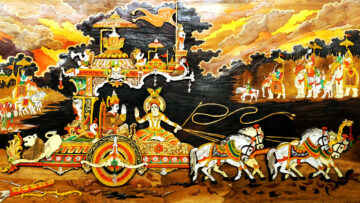
Lord Krishna Himself affirms this truth. In the Bhagavad Gita (17.14), He explicitly lists the worship of the Guru (Seer) not merely as a sentiment, but as a form of sharira tapas (physical austerity).
देवद्विजगुरुप्राज्ञपूजनं शौचमार्जवम् ।
ब्रह्मचर्यमहिंसा च शारीरं तप उच्यते ॥
deva-dvija-guru-prājña- pūjanaṃ śaucam ārjavam।
brahmacaryam ahiṃsā ca śārīraṃ tapa ucyate ॥
(Worship of the Deity, the Twice-born, the Guru, and the Wise, along with purity (shaucam), uprightness, celibacy, and non-violence, these are declared to be the austerity of the body.)
Conclusion: “Sanctity over Convenience”
Unlike environments where rules are enforced with a terrifying “because I said so,” the Dvaita tradition offers these rules as a form of spiritual hygiene.
We are used to sterilizing our hands before entering an ICU to protect the patients. Similarly, the Maṭhas ask us to sterilize our attire, our state of mind, and our ritual purity before entering the sanctum, to protect the spiritual energy that benefits the society.
When a woman drapes a saree, or a man ties a dhoti, or we step back during impurity, we are not blindly obeying a rule. We are participating in the preservation of a Vedic lineage. We are telling the Seers:
I value the sanctity of this place more than my personal convenience.
There is great admiration in this discipline. It ensures that when we finally extend our hands for the teertha, regardless of the hand that pours it, the water we receive is not just water. It is a current of electric grace, preserved in its purest form, ready to heal our lives.
Feature Image Credit: wikipedia.org
Disclaimer: The opinions expressed in this article belong to the author. Indic Today is neither responsible nor liable for the accuracy, completeness, suitability, or validity of any information in the article.