
Sonic Hierarchy and the Deva/Asura Divide in Kerala Percussion
In the dimly lit interior of a Koothambalam, the sacred theatre attached to a Kerala temple, two percussion instruments preside over a performance that has endured for more than two millennia. One is a large copper pot drum, its single leather face pointed upward toward the heavens, played with bare hands by a hereditary Brahmin percussionist seated at the rear of the stage. The other is a cylindrical wooden drum, suspended from the neck of its player and struck with curved sticks, its thunderous sound capable of being heard from considerable distances outside the theatre walls. Both are indispensable to Kerala’s classical and ritual performance traditions. Yet within the interpretive and ritual vocabulary of these traditions, they are frequently positioned in strikingly different terms: the Mizhavu is often described as Deva Vadyam (instrument of the gods), while the Chenda is characterised as Asura Vadyam (instrument of the asuras).
This essay examines the philosophical, aesthetic, and social logic through which this distinction is articulated and sustained. The contrast between the Mizhavu and the Chenda is not simply a matter of assigning different instruments to different contexts. Rather, it condenses a set of recurring oppositions—between interior and exterior space, between meditative elaboration and outward projection, between textual anticipation and collective activation—that structure Kerala’s performance traditions at multiple levels. The Deva/Asura distinction, I argue, is best understood not as a fixed theological system but as a working cosmological idiom: a way in which practitioners, texts, and institutions organise the relationship between sound, space, affect, and authority. To attend to this idiom is to recognise that in these traditions, sound is rarely treated as a neutral acoustic phenomenon. It is instead embedded in a broader field of meaning in which sonic practice intersects with ritual, hierarchy, and knowledge. The orchestra pit, in this sense, is not merely a site of accompaniment; it is a site where different forms of sonic power are differentiated, negotiated, and made intelligible.
The Cosmological Grammar of Kerala Percussion
Kerala’s performance traditions — above all Koodiyattam, the sole surviving form of ancient Sanskrit theatre, operate within a richly articulated cosmological framework. Sound itself, in the philosophical substratum of these traditions, is not a neutral physical phenomenon but a manifestation of the divine. The concept of Nada Brahman — the universe as primordial sound runs through the Vedic, Tantric, and Shaiva traditions that underlie Kerala’s temple culture. Within this framework, musical instruments are not tools but sacred entities, each carrying a specific cosmological identity and function.
The classification of instruments as Deva Vadyam (instrument of the devas) or Asura Vadyam (instrument of the asuras) reflects this metaphysical seriousness. It is not a casual folk designation but a theologically loaded taxonomy rooted in the cosmic opposition between the devas — celestial, ordered, Brahminic and the asuras — chthonic, unruly, powerful. The two categories are not a simple hierarchy of the sacred over the profane. Rather, they reflect two different orders of sacred power: the refined, interiorised power of the divine court versus the raw, expansive power of the demonic; and two different modes of sacred function.
The mizhavu belongs firmly to the first category. Classified in the Natya Shastra of Bharata Muni as the Urdha mukha Mrdangam— the upward-facing drum— it is described as a Deva Vadyam and accorded the Sanskrit designation Brahmacharya: the status of a celibate Brahmin scholar. The chenda, by contrast, is consistently classified as Asura Vadyam — an instrument whose power is uncontainable within the refined boundaries of the temple interior, whose sound is too vast, too outward-projecting, too unruly to serve as the primary accompaniment of Sanskrit drama.
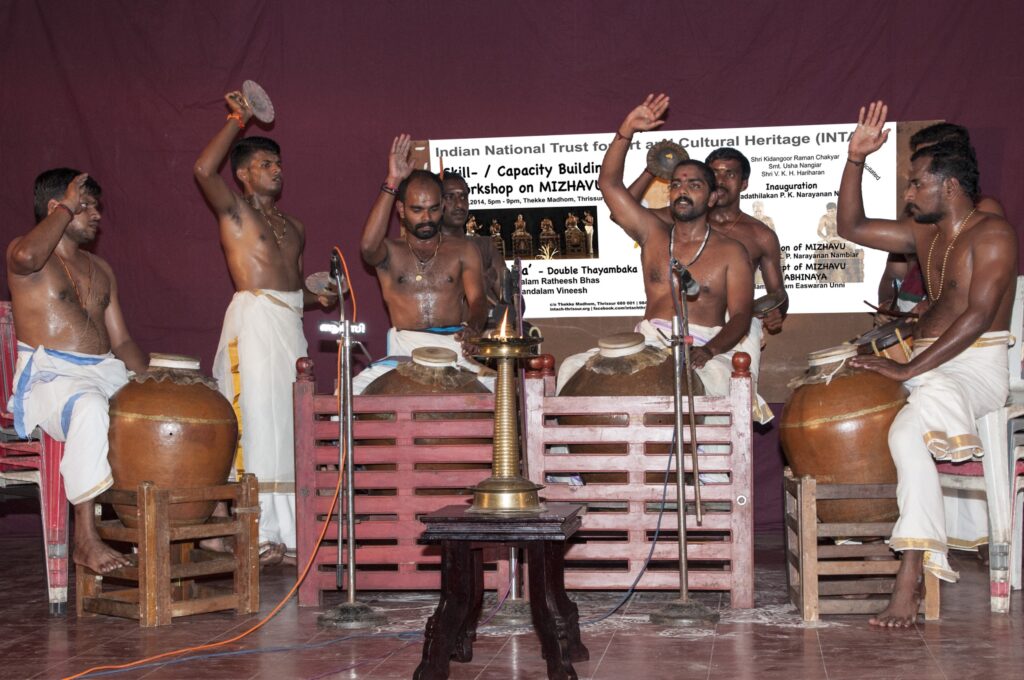 (Figure 1: Credit: INTACH Thrissur – Performers strike traditional Kerala percussion in a moment of rhythmic intensity)
The Mizhavu: The Drum That is a Brahmin
Among percussion instruments in South Asia, the Mizhavu occupies a distinctive position due to the elaborate ritual practices that surround it. Ethnographic and textual sources describe a sequence of ceremonies performed at different stages of the instrument’s existence, including rites analogous to naming, initiation, and, at the end of its usable life, ritual interment within temple precincts. Such practices have often been interpreted as attributing a form of ritual personhood to the instrument.
The mizhavu is traditionally played exclusively by men of the Ambalavasi Nambiar community, for whom it is a hereditary vocation. Their Sanskrit designation, Panivada — literally “one who plays with hands” defines both their technique and their social identity. During a Koodiyattam performance, the Nambiar percussionist appears in the traditional attire of a Brahminic ritual specialist: a white mundu worn around the waist, bare above the waist in the temple interior. He takes his seat within the mizhavina, a specially constructed wooden enclosure at the rear of the stage, from which he does not move throughout the performance. Beside him, to his left, sits the edakka player; to his right, Nangyaramma, the Nambiar woman who wields the kuzhitalam (small cymbals) and recites Sanskrit verses. She is the only woman in the instrumental ensemble.
The training that qualifies a Nambiar for this role is as unusual as the instrument itself. Students begin practice not on the mizhavu but on stones and wooden blocks, conditioning their hands before they are permitted to touch the sacred copper surface. They then progress through smaller versions of the instrument before graduating to the full-sized drum. The formal curriculum as standardised at Kerala Kalamandalam after 1965— runs to four years, covering all five tala patterns (Ekam, Chembada, Adantha, Chemba, and Panchari) as well as the textual knowledge of the Kramadeepika and Attaprakaram stage manuals. But true mastery takes years, the percussionist must internalise not merely rhythm but the entire emotional and narrative arc of every play, since he cannot see the actor he accompanies.
No other percussion instrument in the Indian subcontinent has been accorded the degree of theological personhood that the mizhavu commands. The rituals surrounding it constitute nothing less than a complete human biography in sound. When a new mizhavu is made, whether of clay in the older tradition or of copper in the contemporary practice — it is not merely manufactured but born. Fourteen of the shodasakriyas, the sixteen brahminical rites of passage, are performed over the instrument: jatakarma (birth rites), namakarana (naming ceremony), karnavedam (ear-piercing), annaprasam (first feeding), and upanayanam (sacred thread ceremony)— at which the instrument itself is adorned with the yajnopavita, not the player among them. The only ceremony withheld is vivaha — marriage — for the mizhavu is a brahmachari, a celibate scholar devoted entirely to its sacred function. When an old mizhavu becomes unfit for use, it is not discarded but buried within the temple precincts with the full death rites befitting a respected Brahmin.
This remarkable anthropomorphism is not merely ceremonial excess. It encodes a precise theological claim, that the mizhavu is not an object used to make music but a living participant in the sacred performance, whose sound is not produced but given. The percussionist does not play the mizhavu so much as collaborate with it. The instrument carries within itself the accumulated sanctity of its brahminic biography, and this sanctity is what enables it to sustain the ritual space of Koodiyattam performance.
The mythological origin narrative reinforces this. The Nambiar community traces the instrument to the cosmic dance of Lord Shiva at Chidambaram, where Nandikeswara, Shiva’s bull-headed gatekeeper and chief devotee, played the mizhavu to accompany the Ananda Tandava, the dance of cosmic bliss. The same primordial sound that attended the universe’s most sacred dance is what the Nambiar percussionist reproduces in the Koothambalam. Performance is cosmological repetition, and the mizhavu is the instrument of divine origination.
Structurally, the mizhavu is unique in India. The Natya Shastra identifies three varieties of Mrdangam; the Urdha mukha (upward-facing) type describes the mizhavu’s distinctive posture, with its single leather face pointing skyward. No other Urdha mukha Mrdangam exists anywhere else in India. This structural singularity mirrors its cosmological singularity: it is the instrument designated to serve the most ancient surviving form of Sanskrit drama.
The Chenda: The Drum That Cannot Be Contained
If the mizhavu is the quintessence of interior sacred refinement, the chenda is its cosmological complement — not its opposite in the sense of profanity, but the vessel of a different, more outward-directed sacred power. Its classification as Asura Vadyam does not mean it is impure or irreligious. Without the chenda, the great temple festivals of Kerala — the magnificent Panchari melam and Pandi melam that thunder through the courtyard air at Thrissur Pooram and a hundred other festivals would be inconceivable.
The chenda’s mythological biography is also Shaiva but structured differently from the mizhavu’s. Among the Malayar community— its traditional caste of players in northern Kerala, the instrument was blessed directly by Shiva and entrusted to them as a sacred charge, synonymous with their mantravadha (sacred sound ritual) tradition. Yet where the mizhavu’s Shaiva lineage runs through the refined, interiorised devotion of Nandikeswara playing for the cosmic dance, the chenda’s Shaiva lineage runs through the untamed, exteriorised power of Shiva as the destroyer, the lord of cremation grounds, the deity who is himself beyond the boundaries of Brahminic propriety.
While many women are playing chenda nowadays, historically chenda was an exclusively male instrument. Its players, drawn from the hereditary Marar and Poduval communities of Ambalavasi percussionists, begin their training in a kalari or traditional school, typically from childhood. Mastery demands years of physical conditioning alongside rhythmic education: the instrument is heavy, hung from the neck, and played with two curved sticks whose technique requires both stamina and precision. During melam performances, players present themselves in traditional white mundu— bare-chested in older temple practice, though covered in contemporary public contexts. Ensembles of dozens, and at Thrissur Pooram hundreds, of players line up in disciplined rows, their coordinated strikes producing a sonic field of extraordinary communal power.
This sonic character maps directly onto the instrument’s cosmological position. The mizhavu, played with bare hands on a copper vessel, produces a deep, resonant, atmospheric sound that permeates the Koothambalam’s interior without dominating it. Contemporary descriptions characterise it as an instrument whose function is to “paint the atmosphere” — to create an affective field around the actor’s performance rather than punctuating it. The chenda, by contrast, struck with curved sticks on a taut double-headed cylindrical drum, produces what is arguably the loudest acoustic output of any hand-operated percussion instrument in South Asia, audible for up to three kilometres. It does not fill an interior space; it commands exterior space, projecting outward across temple courtyards, elephant processions, and open festival grounds.
Recent neuroacoustic research has added an empirical dimension to this traditional characterisation. Studies indicate that the high-amplitude fluctuations in the chenda’s sound create fractal structures that engage the brain’s dopamine and motor activity centres, inducing in listeners an instinctive response of hand gestures and rhythmic movement The chenda does not merely accompany communal participation; it neurologically compels it. This involuntary collective activation is precisely what renders it unsuitable for the meditative, slow-unfolding world of Koodiyattam but indispensable for Theyyam, Kathakali’s battle sequences, and the great outdoor melam performances.
Comparative Analysis: Interior vs. Exterior Signification
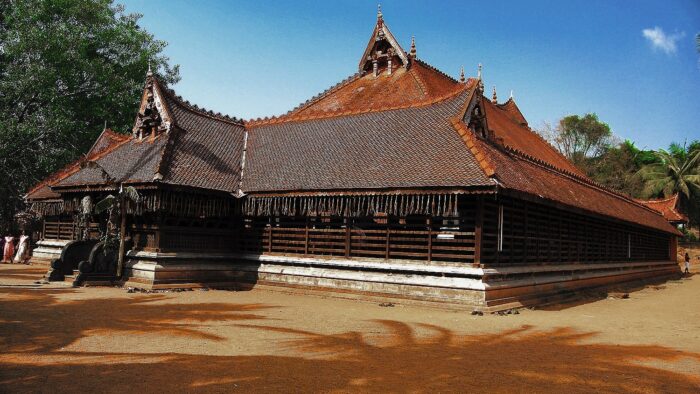
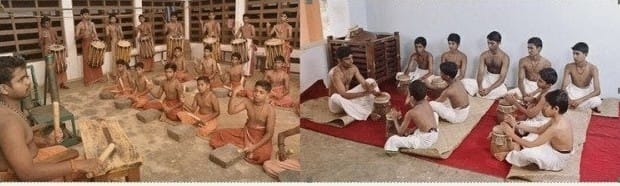 (Figure 2: Students inside the Koothambalam)
The Deva Vadyam / Asura Vadyam distinction can be mapped onto a series of interlocking structural oppositions that run through Kerala’s performance culture. These are not mere descriptive differences but systematic aesthetic and theological principles.
Space and Acoustics: The mizhavu belongs to the Koothambalam — an enclosed temple theatre constructed according to precise specifications of the Natya Shastra and the Kerala tantric text Thantrasamuchaya, its wooden pillars and tiered roof calibrated for resonance in intimate performance. The chenda belongs to the nadupura and the open temple courtyard — processional and festival spaces where its volume is not a liability but a necessity.
Temporal Structure: The mizhavu sustains the extraordinarily slow temporal world of Koodiyattam, where a single act can unfold over forty or more nights and each Sanskrit verse is elaborated through layers of mime, facial expression, and narrative digression. Its tala cycles — primarily Ekam, Adantha (fourteen beats), and Chembada (eight beats) create a measured temporal container for rasa elaboration. The chenda’s kaalam structure, by contrast, is architectured around acceleration: rhythmic cycles progress through geometrically doubling speeds, building toward a communal crescendo at the kalaasam.
Gender and Rasa: Both the mizhavu and the chenda are played mostly by men, though nowadays women are also playing. However, in Kathakali performances, the chenda accompanies male characters and heroic or violent scenes, while the maddalam — a softer barrel drum, also a Deva Vadyam — accompanies female characters and lyrical sequences. The mizhavu, serving the entire emotional range of Sanskrit drama, must be capable of signifying all nine rasas; it is, in a sense, beyond this gendered division — a brahmachari instrument for a tradition that aspires to the full compass of human and divine emotion.
The Performer’s Epistemic Position: One of the most striking asymmetries between the two instruments is the epistemic situation of their players. The mizhavu player is seated behind the actor in the Koothambalam, entirely unable to see the performer’s mudras, facial expressions, or eye movements. Yet the drum must mirror the actor’s internal emotional state in real time. This is only possible because the Nambiar percussionist has internalised the complete textual knowledge of every play through study of the stage manuals. The drum’s signs are generated not through visual reading of the body but through textual-mnemonic anticipation: a prospective signification based on deep knowledge of what the actor must be feeling at each moment. The chenda player in Kathakali, by contrast, watches the actor intently, following gestural and vocal cues in real time, and in certain passages effectively leads the dramatic pacing.
Rasa, Tala, and the Grammar of Sacred Affect
The most intellectually rich dimension of this cosmological divide is its relationship to rasa theory — the doctrine of aesthetic emotion that governs all Sanskrit performance. The Natya Shastra identifies nine primary rasas: shringara (love), hasya (humour), karuna (pathos), raudra (fury), vira (heroism), bhayanaka (terror), bibhatsa (disgust), adbhuta (wonder), and shanta (peace). Each rasa is mapped, in the Kerala tradition, onto specific tala patterns that the mizhavu must embody.
The standard rasa-tala mapping in Koodiyattam assigns Ekam and Adantha to most rasas, with Chembada as an alternative. The two exceptions are instructive: vira (heroism) and raudra (fury) require different, more energised tala patterns— Adantha or even Triputa. This is precisely where the boundary between the mizhavu’s world and the chenda’s world becomes musically audible. The rasas the mizhavu handles most fully— love, grief, wonder, peace are the interiorised, contemplative emotions of Sanskrit dramatic poetry. The rasas where it approaches the edge of its expressive range — fury, heroism — are the emotions that are the chenda’s natural domain in Kathakali.
The two instruments are thus not in competition but in systematic complementarity. Together, they cover the full spectrum of Kerala’s sacred performance. One serves the ancient, temple-interior, textually dense world of Sanskrit drama, where performance is meditation and the audience is a congregation of cultivated listeners. The other serves the outdoor, communally participatory world of temple festivals and popular theatre, where performance is proclamation and the audience is a crowd moved to collective feeling.
Varna, Transmission, and the Politics of Sacred Sound
The cosmological divide between Deva Vadyam and Asura Vadyam is not merely metaphysical. It is also a social and varna-inscribed division with profound implications for the transmission of knowledge and the social organisation of sacred performance.
The mizhavu has historically been the exclusive preserve of the Ambalavasi Nambiar community. Only Nambiars could play it within temple precincts and Koothambalams, just as only Chakyars could perform the acting roles and only Nambiar women (Nangiars) could perform Nangiarkuttu, the female solo form. This triple caste-locking of an entire art form — actors, percussionists, and female performers all drawn from hereditary communities — ensured extraordinary continuity but also extraordinary vulnerability. Crucially, even within the tradition, actors and drummers did not rehearse together; in the words of Koodiyattam performer Margi Madhu, “they met only on stage.” The performer and his percussionist arrived separately, having separately internalised the same textual tradition, and met in the live event of performance.
The UNESCO recognition of Koodiyattam in 2001 as a Masterpiece of the Oral and Intangible Heritage of Humanity added a further layer of complexity. International legitimation brought resources and visibility, but it also brought the risk of decontextualisation— of a tradition whose meaning is inseparable from its temple setting being understood primarily as a “world theatre” form for global festival circuits. The mizhavu, as the sacred centre of that tradition, is caught between two imperatives: survival through democratisation and integrity through ritual specificity.
Conclusion: Sound as Cosmology
The Deva Vadyam / Asura Vadyam divide is ultimately a statement about the nature of sound itself within the worldview of Kerala’s classical traditions. Sound is not neutral. It carries within it the cosmological identity of its source— the refinement and interiority of the divine order, or the rawness and exteriority of the demonic and this identity shapes what it can and cannot do, what spaces it can inhabit, what emotions it can sustain, what communities it can serve.
The mizhavu and the chenda are, in this light, not simply two percussion instruments with different physical properties and social histories. They are two theories of sacred sound, embodied in copper and wood, sustained by communities whose very social identities are defined by their relationship to these instruments. The mizhavu’s brahmachari personhood, its sixteen rites of passage, its role as the primary acoustic vehicle of the world’s oldest surviving Sanskrit theatre — these are not ethnographic curiosities. They are expressions of a philosophy of sound in which the drum is a being, performance is cosmological repetition, and the theatre is a temple in the fullest theological sense.
To sit in a Koothambalam and hear the mizhavu begin its slow atmospheric elaboration of a Sanskrit verse that was being elaborated in the same space a thousand years ago is to experience, however incompletely, what that philosophy means in practice. The orchestra pit, in this tradition, is not a space of accompaniment. It is a cosmological frontier, where gods and demons take their appointed places and the ancient argument between refinement and power, interiority and exteriority, is worked out anew— in rhythm, in time, in sacred sound.
Disclaimer: The opinions expressed in this article belong to the author. Indic Today is neither responsible nor liable for the accuracy, completeness, suitability, or validity of any information in the article.