
An exploration into the nature of Ultimate Truth
In the modern worldview the value of a thing is calculated by the utility that it provides. But can the same criteria be applied to Truth? Is Truth valuable to us merely because it is useful? Is Truth a means to an end or an end in itself?
Truth
We don’t experience Truth as merely useful information but as something very fundamental. Truth does not have merely an instrumental value, but we instinctively value Truth for its own sake. Truth is not only a window to reality, but Truth is reality as it is. Truth does not stand apart from the reality it reveals. Hence, the character of Truth is determined by the reality it describes.
The act of apprehension of the Truth happens always in the present. Truth and the reality it reveals share the same temporal locus. For example If we say that dinosaurs existed millions of years ago, the apprehension occurs now, while both the Truth-content and the reality it reveals are in the same temporal locus i.e. the past.
Relative Truth
Phenomenal existence is characterized by mutation, perishability and differentiation. Therefore, those Truths which characterize such a relative existence are themselves changing and conditioned. Such Truths are relative Truths. Relative Truths are conditioned by the realities they reveal because the stability of the Truth depends upon the stability of the reality it describes. When the relevant reality changes, the Truth pertaining to that state ceases to hold. Relative Truths enable us to understand and navigate the phenomenal world. They solve problems and provide genuine knowledge. Entire scientific and technological progress of this civilization has occurred by understanding these Truths. But it remains a fact that the value of these relative Truths is tied intricately with the finite realities they describe. They cannot transcend the limitations posed by finitude, mutation, perishability and differentiation. Relative Truths cannot provide an unchanging ground for a life lived within a changing reality. They cannot Ultimately free us from finitude, sorrow and ignorance. They also cannot satisfy our deepest longing for something infinite, eternal, complete and unchanging.
If every Truth available to us is thus conditioned by changing reality, then none of them can be the Ultimate Truth. Yet our longing for Truth appears to reach beyond mere relative. What if there is the possibility for a Truth that is not conditioned by phenomenal existence. If such a Truth exists, what would it have to be?
Absolute Truth
Since we have seen the inadequacies of relative Truths, Absolute Truth must be fundamentally different from it. Relative Truths reveal relative existence; Absolute Truth reveals Absolute existence, the one ground of Being from which everything has sprung up. Absolute existence is unchanging, infinite and immutable. We have already accepted that Truth doesn’t stand apart from the reality it reveals. Hence Absolute Truth is nothing but Absolute existence itself. It is here that we can see Absolute Truth transcending the limitations of relative Truths. It is the one reality that can be counted upon to never change.
Relative Truths depend upon the reality they reveal. Absolute Truth doesn’t depend upon anything external to establish or reveal itself. Nothing stands outside the Absolute as its Ultimate ground. Therefore, Absolute Truth shines forth by its own light. Relative Truths provide only relative solutions and temporary relief. Absolute Truth alone is free from limitations. Liberation is not a product of the Absolute, it is its very property. Freedom is intrinsic to that which is not bound to anything. Absolute Truth therefore is not merely a means to liberation; it is an end in itself.
The question now is does such an Absolute Truth exist? And if it does, what is it and where is it revealed?
Bhagavatham
The great Rishi Veda Vyasa after dividing the entire Vedic corpus into four parts and various Shakha-s, composed the Purana-s and the Mahabharata. Yet he remained dissatisfied because he felt he had not expounded on the Ultimate Truth adequately. His answer to this dissatisfaction descended as a blessing for humanity in the form of the Srimad Bhagavatha Mahapurana.
We remember the Bhagavatham by beautiful descriptions of the Avatara Leela-s of Sri Vishnu, the heart melting divine Leela-s of Krishna and the devotional stories of great Bhakta-s. But Vyasa doesn’t begin Bhagavatham by describing Krishna in his four handed Vishnu Swaroopa or by his divine enchanting form playing flute. He begins by instructing us to meditate upon the Absolute Truth, सत्यं परं धीमहि.
धाम्ना स्वेन सदा निरस्तकुहकं सत्यं परं धीमहि ।।१
Contemplation of the Ultimate Truth, परं सत्यं, is fundamental to the Bhagavatham. And Bhagavatham describes this Truth closely mirroring the formulations in our discussions in the earlier sections.
धाम्ना स्वेन– The Supreme Truth shines by its own light. It doesn’t need any other proof or Truth to illuminate it. Because all other Truths are relative in nature and describe only relative existence.
सदा निरस्तकुहकं– The Supreme Truth is eternally free from falsity, illusion and limitation. It transcends the limitations posed by relative Truths.
सत्यं परं धीमहि– Commentators such as Sridhara Swami treat this as an instruction to meditate upon the nature of Absolute Truth to break free from the limitations posed by the phenomenal world.
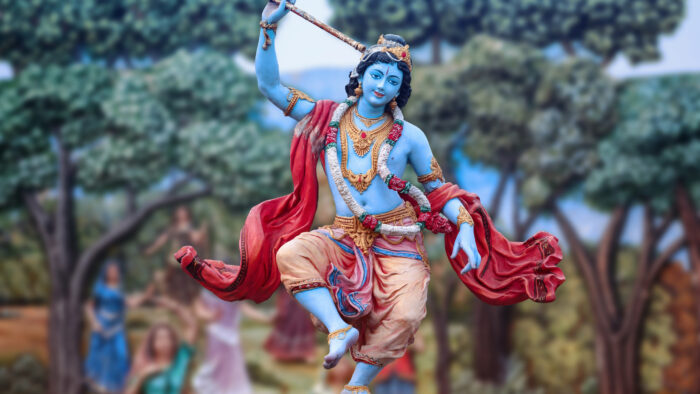
The beauty of the Bhagavatham stands in the fact that it doesn’t leave this Supreme Truth as an abstract philosophical principle. The Supreme Truth is revealed as Bhagavan, as Krishna. Krishna is therefore not merely a character described by the Bhagavatham. Krishna is the Param Satyam that the Bhagavatham reveals. All the Leela-s, all the actions of Krishna are, in fact the acts of Absolute Truth playing within the realm of relative Truths. Bhakti is not merely emotional outpouring, but it’s the encounter of a limited consciousness operating in the world of relative Truths with the Absolute Truth. That response can take the form of love, ecstasy, wonder, surrender, silence and even fear. Arjuna was visibly shattered by awe and fear when he saw the Visvarupa of Krisha. The devotional aspect of Bhagavatham is not separate from its inquiry into Ultimate Truth. Devotion is the emotional response of a limited consciousness to the magnitude of Ultimate Truth.
We began by asking whether Truth is valuable merely because it is useful. Relative Truths are valuable because they are useful. The Bhagavatham adds by asking us to meditate on that which transcends these relative Truths. That which gives value to these other Truths. This meditation shall reveal that the Truth we are seeking is not merely an abstraction. It takes a form, speaks to us, loves us. That Truth is Krishna.
Feature Image Credit: IStock
Disclaimer: The opinions expressed in this article belong to the author. Indic Today is neither responsible nor liable for the accuracy, completeness, suitability, or validity of any information in the article.