
Inside the Extraordinary Journey of Yogi Dileep Kumar
The man who helped carry yoga from India’s ancient tradition to the floor of the United Nations does not live behind ceremony or spectacle. He lives simply — and it is in that simplicity that his presence speaks most powerfully.
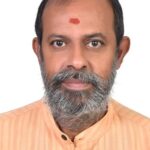
Dileep Kumar Thangappan — known to the world as Yogi Dileep or simply Guruji — is the quiet force behind one of modern India’s most visible global contributions: the United Nations’ International Day of Yoga, observed every year on June 21. From a childhood shaped by interfaith love and community care in Kerala, to decades of teaching across New York gyms, Himalayan caves, cathedral halls and UN platforms, his journey embodies a rare blend of grassroots perseverance and universal spirituality.
This conversation took place at Dileepji’s residence, Yogabhavan, in Kochi—a space that feels less like a private home and more like a natural extension of his life’s work. On the appointed day, he welcomed me into his sprawling first-floor drawing room, a calm, sunlit expanse where light streamed freely through several windows. With gentle warmth, he invited me to sit beside him on the sofa, offered light snacks and a refreshing glass of lemon juice, and began speaking not as a distant spiritual figure, but as a deeply attentive, simple human being.
Before the formal interview began, he led me through the large hall within the residence where yoga classes are regularly conducted. The space carried the quiet energy of discipline, and inner effort — a place where seekers gather not merely to stretch the body, but to reshape their lives. It served as a subtle reminder that for Dileepji, yoga is not an abstract philosophy but a lived, daily practice.
What follows is shaped by the life and vision he embodies, but it is not a portrait drawn directly out of personal interaction and lived conversation with him. It is the voice of the man himself — reflective, candid, and grounded in experience. In this intimate conversation, held on the eve of another International Yoga Day season, Dileepji speaks openly about his roots, the masters who shaped him, the near-miraculous survival of his own birth, and his conviction that true spirituality must transcend religion, borders, and even politics.
It is not just an interview. It is an encounter with a life shaped by fire, faith, and an unshakeable belief in the oneness of humanity.
Dileepji, thank you for speaking with us. Let’s go to the roots. When did your spiritual journey truly begin?
In many ways, it feels as though it began before I was even conscious of it. My father came from a Christian family tracing its lineage to the St. Thomas converts of 1852; my mother belonged to a Hindu family. Their marriage was a love marriage, fiercely opposed by both communities. But that resistance only strengthened them. They became, as I often say, like diamonds forged under pressure.
I grew up moving naturally between church and temple, without any sense of contradiction. I respected both spaces, but I was never drawn to organised religion. I deeply admired the teachings of Jesus, yet institutional faith never resonated with me.
Another influence was the way I was raised. I was the youngest among friends and relatives; everyone older, everyone protective. My parents worked, my siblings went to school, so neighbours and friends’ families looked after me in the evenings. I was raised by a community, not just a household. That experience quietly shaped my worldview — the feeling that we are all interconnected.
Was there a moment in childhood that deeply altered you?
Yes — one incident never left me. I was just three-and-a-half years old. We lived in a rented building. The landlord’s son deliberately set the house on fire to force tenants out and raise rents. There was a paint shop downstairs; the flames spread rapidly. Everyone fled. In the chaos, I was left behind.
I cried out, but no one heard me. At the last moment, my sister remembered “the little one,” ran back into the burning building, caught hold of my leg and dragged me out. That image of fire has remained etched in my mind.
Years later, in 1989, a spiritual master asked me, “Do you still carry the fire in your head?” I answered yes. That experience made me confront difficult questions about cruelty, greed, and the ways in which human beings harm one another for money. Those questions have guided much of my inner journey.
You began practising yoga very early. Who first guided you?
My parents were my first gurus. My mother had a serious heart condition; doctors gave her only months to live. My father encouraged her to practise yoga, avoid sugar, salt, and oil, and follow simple homeopathic remedies. She lived for another twenty-seven years. I was born after that transformation.
Yoga was never presented to me as a discipline — it was simply life. Both my parents practised daily. Later, I explored many traditions: magnetotherapy, nature-cure movements, Vivekananda Kendra in Kanyakumari, Sivananda Ashram programmes. I spent time with Dr. H.R. Nagendra, worked as staff at different centres, taught in Pune, helped build halls.
But I never confined myself to a single lineage. For me, the entire universe is the guru.
You often speak of three masters who, in a sense, saved your life even before your birth.
That is true. My parents already had two children. When my mother conceived me, finances were strained. My father suggested abortion. My mother refused.
Through a devotee doctor who was close to our family, she consulted Sathya Sai Baba. His message was clear: “Do not kill this child. He will become a yogi.” The same message came independently from Guru Nithyanidhi, my mother’s cousin, and from Prabhaakara Siddha Yogi, a silent saint who lived near the Poornathrayeesa temple in Tripunithura. Three voices, one message.
I consider it a rare blessing — three realised souls protecting my life before I even entered the world. Prabhaakara Siddha Yogi, in particular, was extraordinary. One glance into his eyes was enough. No words were needed.
You were also closely associated with Swami Bua, the legendary 123-year-old hatha yogi.
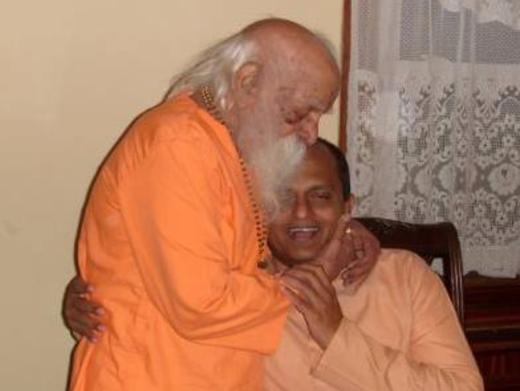
(Figure 1: Dileepji with his Guru Bua ji)
I first met Swami Bua as a child in Tripunithura, and later encountered him again after moving to the United States. He recognised me instantly through a rare birthmark and accepted me closely.
His life itself was a testament to yogic power. He was a cousin of Swami Sivananda, taught hatha yoga to many of Sivananda’s earliest disciples, taught Sanskrit and yoga to Sathya Sai Baba, served as a palace teacher to the Shah of Iran, and travelled around the world nearly ninety times. Even past 120, new teeth were forming, and his hair was turning black again. His vitality was beyond explanation.
In 2008, in New York, he gave me a formal sanyasa initiation. I am the only person he ever initiated.
Today, you are widely recognised as one of the key forces behind the International Day of Yoga. How did that journey begin?
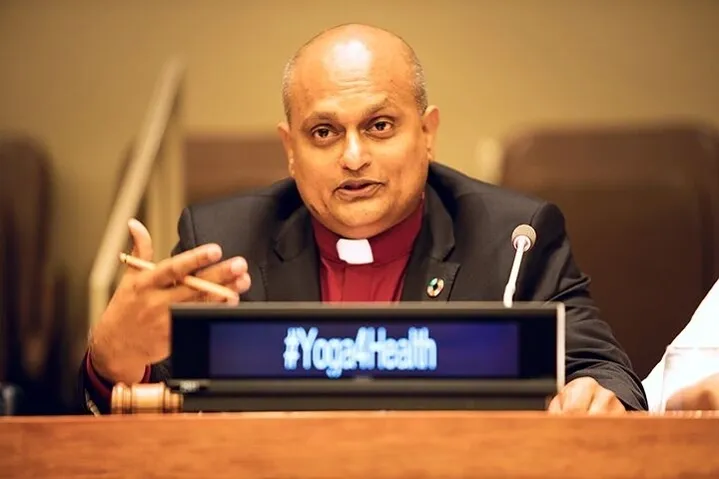
(Figure 2: Guruji H.H. Dileepkumar Thankappan is chairing the NGO Session of the 5th International Day of Yoga celebrations at the United Nations (Room # 4) in 2019.)
Very humbly. In the late 1980s and early 1990s, I would paste handwritten posters in Tripunithura announcing yoga classes. People would tear them down. Yoga was viewed with suspicion in those days. But slowly, a few people stayed. Small groups formed. We focused first on health benefits, and only gradually introduced philosophical ideas.
Years later, while teaching in New York, the thought became clear to me: yoga deserved global recognition through the United Nations. I began mobilising support — reaching out to people like D.R. Karthikeyan, former CBI Director, Dr. H.R. Nagendra, and many others.
When Narendra Modi became Prime Minister, he embraced the idea immediately. In his very first speech at the UN General Assembly in 2014, he proposed June 21 as International Yoga Day. Within months, 177 nations co-sponsored the resolution — the highest number ever for any UN proposal. Ban Ki-moon announced it formally, and the first global celebration took place in 2015.
How has the West responded to yoga since its UN recognition?
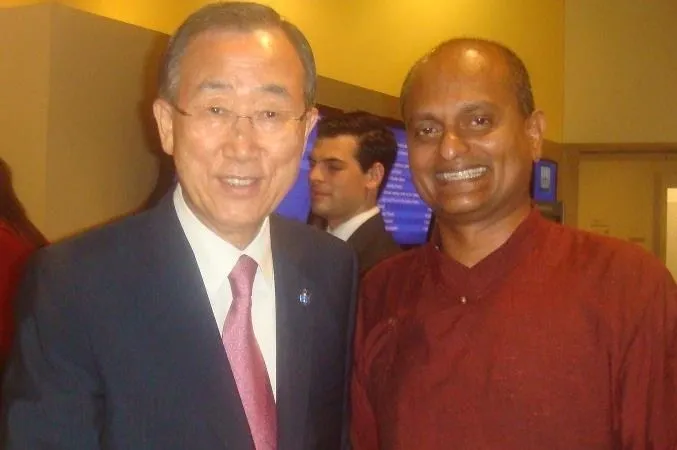
(Figure 3: Guruji H.H. Dileepkumar Thankappan is meeting with H. E. Ban Ki Moon, Secretary-General of the United Nations in 2012)
It transformed into a mass movement almost overnight. Legal recognition brought legitimacy. I have conducted yoga sessions in extraordinary spaces — inside Egyptian pyramids with Muslim participants, in churches and cathedrals, across continents.
The method is simple: let people practise first. When they experience the benefits, curiosity arises naturally. There is no need to preach.
You strongly advocate universal spirituality over rigid religious identity. Why?
Because religions are human constructs. Spirituality already exists in the fabric of the universe. Concepts such as Sanatana Dharma and Vasudhaiva Kutumbakam — the world is one family — do not belong to any single nation or religion. They are meant for all humanity.
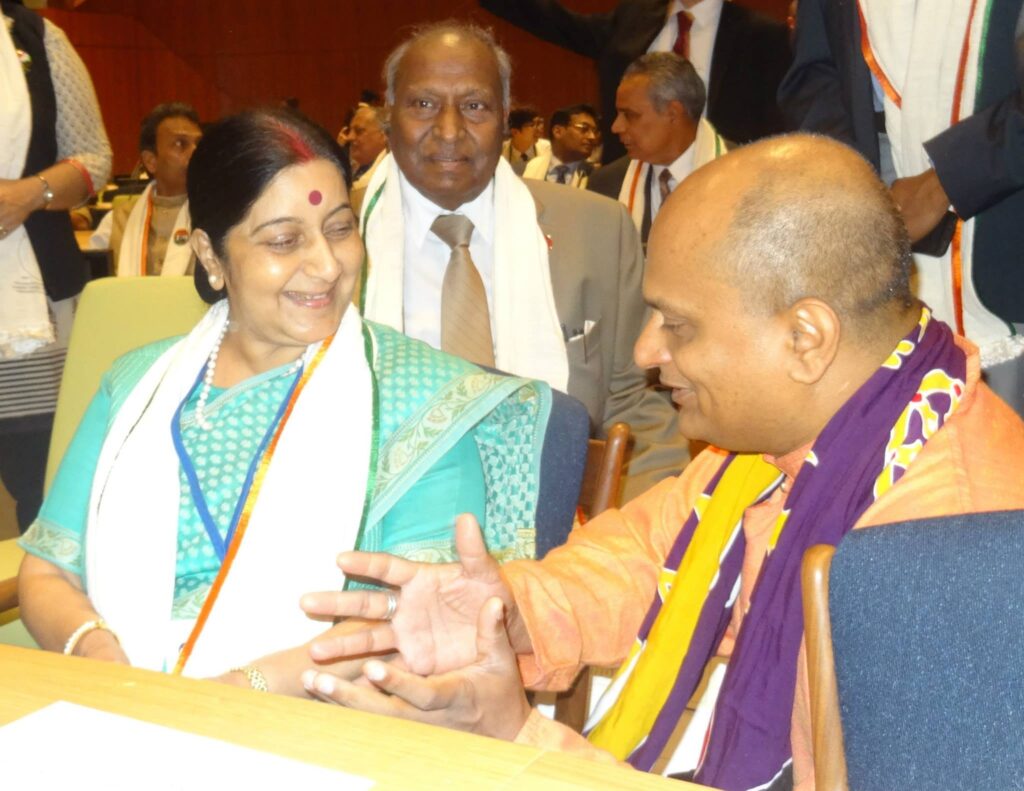
(Figure 4: Dileepji with Late Hon. Sushma Swaraj MP, Minister of External Affairs, India)
When we include rather than exclude, people respond positively. That is why leaders who reach out — like Prime Minister Modi on the global stage — find resonance. But when religions claim monopoly over truth, conflict becomes inevitable.
Interfaith dialogue succeeds only when we recognise that every great master, across time and culture, revealed the same underlying truth — expressed in different forms for different ages.
Finally, what message would you like to give?
Yoga is holistic health — body, mind, and spirit in harmony. Science and spirituality must walk together. Money, degrees, and status do not guarantee happiness.
Live simply. Live humbly. Stay connected to nature and to one another. Protect the earth. Protect humanity. That is the essence of yoga.
Everything else will unfold in its own time.
Disclaimer: The opinions expressed in this article belong to the author. Indic Today is neither responsible nor liable for the accuracy, completeness, suitability, or validity of any information in the article.