
Introduction
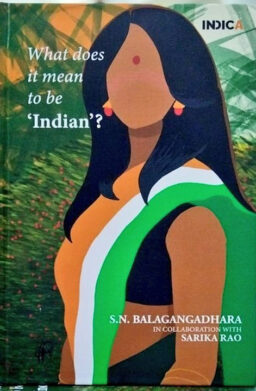
What does it mean to be “Indian”? While the question appears deceptively simple, it has consistently generated confusion, discomfort and ideological polarization in both public discourse and academic inquiry. In What Does It Mean to Be Indian? S. N. Balagangadhara and Sarika Rao argue that this difficulty is not accidental but historically produced. Addressed to an intelligent but lay audience, the book condenses Balagangadhara’s broader theoretical project on colonial consciousness, cultural difference and religion into a focused and accessible intervention.
The authors’ central claim is that Indians today struggle to articulate a coherent sense of collective identity because they continue to describe themselves using conceptual frameworks inherited from colonial rule. These frameworks, they argue, distort Indian experience, undermine indigenous modes of self-understanding, and contribute to recurring institutional dysfunction and social conflict in postcolonial India.
Colonial Consciousness and the Dual Legacy of Colonization
At the heart of the book lies the concept of colonial consciousness, which Balagangadhara defines as both an event and a process. It is an event insofar as it emerged through a historically extended series of actions involving multiple actors over long periods of time. Simultaneously, it is a process because it reproduces itself across generations through education, law and the social sciences.
The authors argue that Indian society has been shaped by two distinct but interconnected colonial experiences: Islamic and British colonization. Islamic colonization, according to Balagangadhara, disrupted indigenous systems of learning by dismantling the intimate link between lived experience and reflective theory that characterized pre-colonial Indian intellectual life. The destruction or marginalization of institutions responsible for knowledge production weakened India’s capacity to generate theoretical reflection on society, nature and morality. Islamic colonialism cut the link between reflections on experience on the one hand and having such experiences on the other by destroying the fecundity of intellectual life in India.
While this disruption damaged Indian culture, it did not destroy it. However, the arrival of British colonialism prevented any meaningful intellectual recuperation. British rule introduced Western epistemic frameworks and created a new class of intellectuals increasingly divorced from experiential reflection, further marginalizing indigenous modes of knowledge production.
Seeing Ourselves as the Colonizer Saw Us
One of the book’s most provocative arguments is that colonialism fundamentally altered how Indians see themselves. Prof Balagangadhara mentioned that Indians have internalized colonial descriptions of their own society-descriptions that portray Indian culture as irrational, religiously fragmented, caste-ridden and morally regressive. These portrayals, originally produced within Western theological and philosophical debates, continue to shape Indian self-understanding through modern social sciences, constitutional law and public discourse.
As a result, indigenous experiences and narratives are treated with suspicion, while Western analytical categories are accepted as neutral and universally valid. When asked what it means to be Indian, individuals often respond either with silence or with borrowed clichés derived from Western political or sociological vocabularies. This epistemic alienation, the authors argue, contributes to India’s persistent struggles with social cohesion and institutional legitimacy despite formal political independence.
Religion, Ritual, and Configurations of Learning
A key conceptual contribution of the book lies in its distinction between different configurations of learning that structure cultures. Balagangadhara argues that Western societies are primarily organized around the category of religion, whereas Indian traditions are structured around ritual practices. Religion, in this analysis, is not a universal human phenomenon but a historically specific Western mode of organizing experience, authority, and morality.
When Western scholars and colonial administrators classified Indian traditions as “religions,” particularly under the umbrella term “Hinduism,” they imposed a foreign conceptual unity onto a diverse set of practices. This imposition, the authors argue, produced systematic distortions by projecting Christian theological assumptions–such as scripture, dogma, priesthood, and law–onto Indian traditions where they did not function in the same way.
The Hipkapi Hypothesis and the Construction of “Hinduism”
To illustrate this epistemic distortion, Balagangadhara introduces the “Hipkapi hypothesis”. In this thought experiment he mentions that, “an extraterrestrial observes many unrelated earthly facts. Grass is green, flowers smell sweet, corpses smell foul, birds fly and milk sours. The extraterrestrial decides that these facts are all connected by a hidden phenomenon called “hipkapi.” For this being, hipkapi serves as both (a) the name for that supposed connection and (b) the explanation for why these diverse facts exist and how they should be studied. To “prove” hipkapi, he points to more raw facts, such as tigers eating deer, dogs chasing cats, and the large size of elephants. He treats their mere existence as evidence for his concept.” However, he overlooks the real issue: it is not whether these facts exist, but whether they justify claiming a unified entity called hipkapi or show that such a thing exists beyond his way of grouping them.
Prof Balagangadhara argues that Europeans did something similar with “Hinduism.” They took various Indian practices and ideas, including temple and murti puja, Brahmin sandhyavandanam, Sahasranamams, the Purushasukta, and concepts of dharma and adharma, along with many deities. Driven by their own theological needs, they linked these practices under one religion called “Hinduism,” portraying Brahmins as its priestly class and interpreting texts like the Purushasukta as the scriptural basis for caste and untouchability. They found something called smritis (Manu smriti, Narad smriti or Yagnyavalkya smriti) with some code of conduct and make it book of law for Hindus, though Narad and Manu smriti are totally different from one another but they make it law book for pan Indian subcontinent Hindus. Missionaries and later liberal thinkers debated whether this “Hinduism” was demonic idolatry or simply polytheism. Yet, both sides assumed that such a unified religious object existed.
The point is not that Western descriptions are entirely false, but that the unity they created reflects their own theological beliefs. They needed to identify something like a single “religion” to understand India, so they constructed one. The question is similar to the hipkapi case: do the undeniable practices and texts actually indicate a real, unified phenomenon called “Hinduism,” or is that unity mostly imaginary genuine for Europeans but not inherent in the Indian materials themselves?
We are the Daiva Pujak not the Murti Pujak
You can ask people in your friend circle, neighbourhood, or even random visitors coming out of a temple. They will say, “I did the puja” or “I had darśana of Ganesh ji, Hanuman ji or whichever deity is inside the temple.” They will never say, “I performed vigraha puja” or “murti puja.”
In India, daiva puja is a valid and sophisticated technology for accessing the Divine. Calling it “idol worship” immediately criminalizes and delegitimizes the practice in the modern linguistic sense. Because linguistics, which somehow originates from secularised Christian theology believes idolatry is a sin. So, we have to somehow beware of our terminologies.
Conclusion
Balagangadhara and Rao do not offer a ready-made definition of Indian identity. Instead, they invite readers to reconsider the conceptual tools through which such definitions are sought. By urging a re-engagement with indigenous categories of experience and reflection, the book opens a space for rethinking not only Indian identity but also the broader relationship between knowledge, power, and culture in postcolonial societies. Whether one ultimately accepts or rejects its arguments, the book succeeds in unsettling inherited assumptions and stimulating serious intellectual debate. Its principal strength lies in its systematic critique of the epistemological foundations of modern social sciences as applied to India. By exposing the theological origins of ostensibly secular categories, the book challenges prevailing assumptions about universality and objectivity in social theory.
Critics may argue that the book underplays internal diversity and contestation within Indian traditions or risks replacing one form of essentialism with another. Nevertheless, even readers who remain skeptical of its conclusions will find its arguments difficult to dismiss, particularly its demonstration of how deeply colonial categories continue to structure contemporary Indian self-understanding.
Disclaimer: The opinions expressed in this article belong to the author. Indic Today is neither responsible nor liable for the accuracy, completeness, suitability, or validity of any information in the article.