
(Discovering God Within)
Introduction
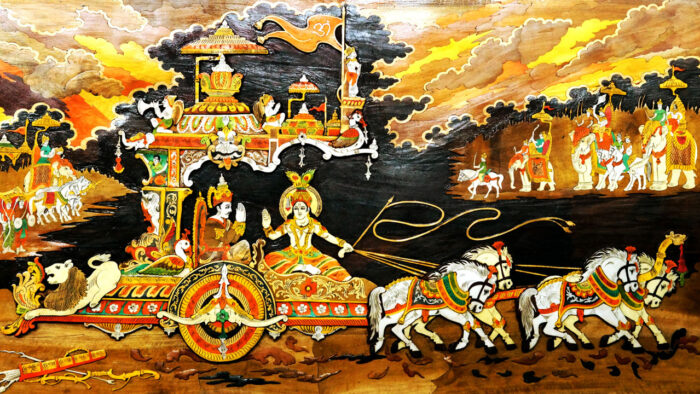
The Bhagavad Gita’s tenth chapter, Vibhūti Yog, is a majestic catalogue of the Divine shining through creation. In the midst of this cosmic vision comes a moment of breathtaking intimacy. Śhrī Kṛiṣhṇa tells Arjun not only that He is the Sun among lights, the Gaṅgā among rivers, and Vyāsa among sages, but also that “Among the Pāṇḍavas, I am Arjun.” It is as if God turns to the seeker and says, “I am you.” This startling declaration dissolves distance between devotee and Lord, reframing the relationship of seeker and sought in a way that still speaks profoundly to us today.
Arjun’s Request
Arjun’s heart overflows with reverence as he listens to Kṛiṣhṇa describe the unfathomable depth of the Divine. Yet, instead of feeling complete, he feels an even greater thirst. With folded hands, he pleads in verses 10.17–18:
कथं विद्यामहं योगिंस्त्वां सदा परिचिन्तयन् ।
केषु केषु च भावेषु चिन्त्योऽसि भगवन्मया ॥ BG १०.१७ ॥
kathaṁ vidyāmahaṁ yōgiṁstvāṁ sadā paricintayan |
kēṣu kēṣu ca bhāvēṣu cintyō:’si bhagavanmayā || BG 10.17 ||
(“O Yogi, how should I know You by constant meditation? In what forms should I contemplate You, O Lord?”)
विस्तरेणात्मनो योगं विभूतिं च जनार्दन ।
भूयः कथय तृप्तिर्हि शृण्वतो नास्ति मेऽमृतम् ॥ BG १०.१८ ॥
vistarēṇātmanō yōgaṁ vibhūtiṁ ca janārdana |
bhūyaḥ kathaya tr̥ptirhi śr̥ṇvatō nāsti mē:’mr̥tam || BG 10.18 ||
(Please narrate again in detail Your divine manifestations and yogic powers, O Janārdana. I can never tire of hearing Your nectar-like words.)
His words reveal the humility of a true seeker. He does not seek answers for curiosity but for inner transformation. For Arjun, each description of the Lord is like an offering of sweetness, yet his yearning only deepens, urging Kṛiṣhṇa to reveal more of Himself.
Bhagavān’s Response: Enumerating the Vibhūtis
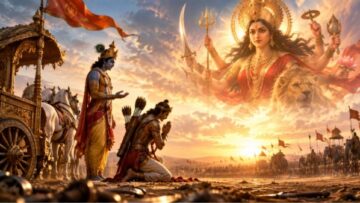
Kṛiṣhṇa responds with compassion to Arjun’s longing, opening before him the vast vision of His vibhūtis, the divine manifestations that shine across creation. He declares His presence in the highest and most glorious expressions: among mountains He is Meru, among rivers the Gaṅgā, among lights the radiant Sun, and among sages the eternal Vyāsa. Each example points to what is supreme, stable, or luminous in its realm, reminding Arjun that wherever greatness shines, it is but a spark of the Divine. This cosmic catalogue is not mere poetry. It is an invitation to see the sacred everywhere. Yet, within this unfolding revelation comes a startling intimacy. In verse 10.37, Kṛiṣhṇa does not point to a distant grandeur—He says, “Among the Pāṇḍavas, I am Arjun.”
वृष्णीनां वासुदेवोऽस्मि पाण्डवानां धनञ्जयः ।
मुनीनामप्यहं व्यासः कवीनामुशना कविः ॥BG १०.३७ ॥
vr̥ṣṇīnāṁ vāsudēvō:’smi pāṇḍavānāṁ dhanañjayaḥ |
munīnāmapyahaṁ vyāsaḥ kavīnāmuśanā kaviḥ || BG 10.37 ||
(Among the Vṛiṣhṇis, I am Vāsudeva; among the Pāṇḍavas, I am Arjun; among sages, I am Vyāsa; among poets, I am Uśhanā.”)
The Surprising Inclusion of Arjun
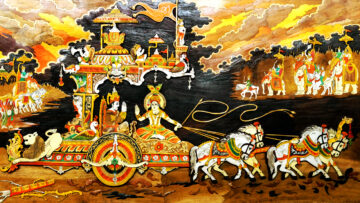
Arjun had placed himself before Bhagavān as a seeker, asking with humility, “How can I know you, and in what forms should I meditate upon you?” He sees himself as the one searching, and Kṛiṣhṇa as the One to be searched for. The relationship seems dual – seeker and sought.
But in verse 10.37, Kṛiṣhṇa quietly shifts that framework. He says, “Among the Pāṇḍavas, I am Arjun.” This is startling because Arjun is the very seeker in front of Him. What does it mean?
1. The dissolving of distance
By including Arjun himself in His vibhūtis, Bhagavān is showing that the Divine is not somewhere far away, waiting to be found only in lofty realms or exalted sages. He is seated right within the very seeker. The search itself rests on the ground of the Divine, and the distinction between seeker and sought begins to soften.
2. Arjun as a channel of vibhūti
Among the Pāṇḍavas, Arjun represents qualities like devotion, courage, humility, and readiness to receive wisdom. By declaring “I am Arjun,” Bhagavān honors those qualities as His own shining presence. It is as if He is saying, “The fact that you can ask such questions, that you thirst for truth – that very impulse in you is Me.”
3. Non-dual hint (Advaitic undertone)
This statement is more than praise. It hints that the seeker and the sought are not two. Arjun’s true self is already one with the Divine. The moment he sees this, the struggle of seeking ends in recognition: “I, who seek, am never apart from That which I seek.”
For devotees, this statement also shows Kṛiṣhṇa’s intimacy with Arjun, affirming that He resides most fully in the heart of His devotee.
It is as if a lamp, searching for light, is told by the flame itself: you already burn with Me. The seeker’s quest is revealed to be rooted in the very presence he is searching for.
4. Practical significance for the listener
For Arjun, this is not abstract. He is being told that his own existence, his own role, and his very name are a manifestation of the Divine. Meditation is no longer about imagining faraway forms alone; it is also about seeing his own life, his own being, as part of the glory of Bhagavān.
So, in this subtle twist, Śhrī Kṛiṣhṇa is not only responding to Arjun’s request but also gently turning the mirror back on him: “You, too, are included in Me. You are not outside this web of divine presence. Among the Pāṇḍavas, I am you.”
Commentarial Insights
Traditional commentators see verse 10.37 as more than a flattering gesture. Śaṅkara emphasizes that by identifying with Arjun, Kṛiṣhṇa points to the non-separation of jīva and Īśvara; the individual self and the Divine are not ultimately distinct. Swami Dayananda Saraswati highlights that Arjun’s very qualities of humility, devotion, and courage are themselves manifestations of Bhagavān’s glory. A. C. Bhaktivedanta Swami Prabhupāda interprets this as Kṛiṣhṇa affirming His presence in His dearest devotee, showing that divine grace flows most fully where devotion is deepest. Modern teachers often add that even the impulse to seek truth is the Divine working within, turning longing itself into proof of God’s nearness.
Practical Reflections for Today
For readers today, verse 10.37 offers more than philosophical comfort; it points toward daily practices that can draw the Divine nearer in lived experience. One way is to keep a simple journal, noting moments where devotion, courage, or humility arise and recognizing them as Kṛiṣhṇa’s presence within.
Another practice is short meditation: sit quietly for a few minutes each day, recalling the words “Among the Pāṇḍavas, I am Arjun,” and allow this truth to soften the sense of distance between seeker and Lord.
Even ordinary questions or longings for meaning can be honored as divine impulses. To live in this awareness is to see the sacred not as remote, but as quietly alive in one’s own heart.
Conclusion
Verse 10.37 of the Gita offers a revelation that is both humbling and liberating. Arjun approaches Kṛiṣhṇa as the seeker, yet Kṛiṣhṇa declares, “Among the Pāṇḍavas, I am Arjun.” The distance between devotee and Lord, seeker and sought, begins to dissolve. This moment teaches that Divinity shines in the vastness of mountains and stars, and equally in the intimacy of our own hearts. To recognize this is to find that the search has never been external; the Divine has always been present within the seeker.
Key Terms
Here are the key terms glossary in alphabetical order
- Advaita: The non-dual vision that sees no ultimate difference between the seeker and the sought, the jīva and Īśvara. Verse 10.37 carries this undertone, hinting that Arjun’s true self is already one with the Divine.
- Arjun (Dhanañjaya): The third of the Pāṇḍavas and recipient of the Bhagavad Gita. In 10.37, Kṛiṣhṇa identifies Himself as Arjun, showing that the seeker is not apart from the Divine glory.
- Bhakti: The path of devotion where intimacy with God becomes central. In the context of 10.37, Kṛiṣhṇa’s identification with Arjun reveals His closeness to the devotee’s heart.
- Bhagavad Gita 10.37: The verse in which Kṛiṣhṇa declares, “Among the Vṛiṣhṇis, I am Vāsudeva; among the Pāṇḍavas, I am Arjun; among sages, I am Vyāsa; among poets, I am Uśhanā.” This verse anchors the article’s theme.
- Jīva: The individual self that experiences life through body and mind. Commentators note that verse 10.37 affirms the non-separation of jīva and Īśvara.
- Īśvara: The Lord, the all-encompassing Divine Reality. In Vibhūti Yog, Kṛiṣhṇa reveals His presence through countless manifestations, including Arjun himself.
- Śhrī Kṛiṣhṇa (Vāsudeva): The speaker of the Gita, who reveals His vibhūtis in Chapter 10. His statement “Among the Pāṇḍavas, I am Arjun” carries both Advaitic and Bhakti meanings.
- Seeker and Sought: The dynamic of spiritual life where the devotee seeks the Divine. Verse 10.37 softens this distance by affirming that the seeker himself is already included in the Lord’s glory.
- Vibhūti Yog: The “Yoga of Divine Glories,” the tenth chapter of the Bhagavad Gita. It describes how God’s presence is revealed through the most exalted expressions in nature, beings, and virtues.
- Vyāsa: The sage traditionally regarded as the compiler of the Mahābhārata and other texts. In 10.37, Kṛiṣhṇa declares, “Among sages, I am Vyāsa,” aligning with the theme of supreme manifestation.
Further Reading
1. Śhrīmad Bhagavad Gita with Commentary by Śhaṅkarāchārya
(Classical Advaita exposition that illuminates the deeper non-dual hints within verses such as 10.37, showing how the seeker and the sought are ultimately one.)
2. Swami Dayananda Saraswati – Bhagavad Gita Home Study Course
(A modern yet traditional unfolding of the Gita that carefully explains the concept of vibhūtis and how they invite a shift in perception of the Divine in all aspects of life.)
3. C. Bhaktivedanta Swami Prabhupāda – Bhagavad Gita As It Is
(Focuses on the bhakti dimension, highlighting how verses like 10.37 reveal the Lord’s intimacy with His devotees and the depth of divine reciprocation.)
4. Chinmaya Mission – The Holy Geeta (Swami Chinmayananda)
(Offers practical and accessible commentary on each verse, with an emphasis on how to apply the vibhūti yog teachings in daily living.)
5. Swami Mukundananda – Bhagavad Gita: The Song of God
(Highlights the devotional and practical teachings of the Gita, with special attention to how vibhūtis can transform our way of seeing the world.)
6. Eknath Easwaran – The Bhagavad Gita
(Presents the Gita with a contemplative voice, guiding readers on how to bring its teachings, including Chapter 10, into the rhythm of everyday meditation and work.)
7. Winthrop Sargeant – The Bhagavad Gita: Translated and with Notes
(A verse-by-verse translation with detailed word-by-word analysis, invaluable for those who want to see the linguistic and philosophical precision of the original Sanskrit.)
(Note on Sources: This article is inspired by Chapter 10 of the Bhagavad Gita—Vibhūti Yog—and reflects on the unique moment when Śhrī Kṛiṣhṇa declares, “Among the Pāṇḍavas, I am Arjun.” The reflections draw upon both classical commentaries and modern interpretations. Insights have been shaped by the works of teachers such as Śhaṅkarāchārya, Swami Dayananda Saraswati, Swami Chinmayananda, A. C. Bhaktivedanta Swami Prabhupāda, Eknath Easwaran, and others who have illumined the Gita’s vision of divine manifestations. While expressed in a contemporary voice for present-day readers, the contemplations remain grounded in the original Sanskrit verses and uphold the philosophical essence of the text.)
Feature Image Credit: istockphoto.com
Disclaimer: The opinions expressed in this article belong to the author. Indic Today is neither responsible nor liable for the accuracy, completeness, suitability, or validity of any information in the article.